
Beat the heat: hydration and heat safety for Maui’s young athletes
Published
Why heat and humidity matter, simple hydration habits, the warning signs of heat illness, and what to do in an emergency, so Maui keiki can play safely in our warm weather all year.
General information, not medical advice. Every child is different. Check with your child’s pediatrician or athletic trainer, especially if your child has asthma, a heart or kidney condition, or takes daily medication. If a young athlete collapses or seems confused in the heat, call 911.
On Maui, heat doesn’t take a season off. Football and cross country are wrapping up, winter sports are starting, and soccer, paddling, beach volleyball and club teams keep playing under the sun all year. Lots of practices happen in the heat of the afternoon, and even a breezy trade-wind day can bring strong sun and sticky humidity. The good news is that heat illness can be prevented when keiki, parents and coaches know what to watch for.
Why heat deserves respect
The National Athletic Trainers’ Association (NATA) calls exertional heat stroke, the most serious kind of heat illness, one of the leading causes of sudden death in sports. The American Academy of Pediatrics (AAP) notes football has one of the highest rates of heat illness, with cross country and soccer also near the top. A CDC study of U.S. high schools from 2005 to 2009 found football players had heat illness at about 10 times the rate of athletes in the other eight sports it tracked. That same report put it plainly: heat illness in high school athletes is preventable.
Why our humidity matters
Sweat cools the body as it dries off the skin. When the air is already full of moisture, sweat dries more slowly, so the body has a harder time shedding heat. That’s why the AAP points to the heat index, which combines temperature and humidity, instead of the temperature alone. It says even 75 to 80 degrees can be risky when the heat index reaches 90°F, a heat index of 105°F or more is a day to limit time outdoors, and parents may want a child to sit out when it climbs into the high 90s. Some schools also use a wet bulb globe temperature (WBGT) reading, which accounts for sun, shade, wind and the playing surface at the actual field.
The AAP says kids raised where it’s warm all year may handle heat better than kids from cooler places, but that’s not a free pass. It also warns that heat illness can happen indoors in spaces without cooling, and that artificial turf can make conditions hotter. So the first week of basketball or wrestling in a warm gym counts too.
Ease into each new season
Bodies need time to adjust to working hard in the heat. NATA recommends building up over 7 to 14 days, slowly adding practice time and intensity and phasing in pads or other gear. The Korey Stringer Institute at the University of Connecticut lists tips such as only one practice a day during the first five days and no full gear until day six. Ask your child’s coach how the first couple of weeks are planned.
Simple hydration habits
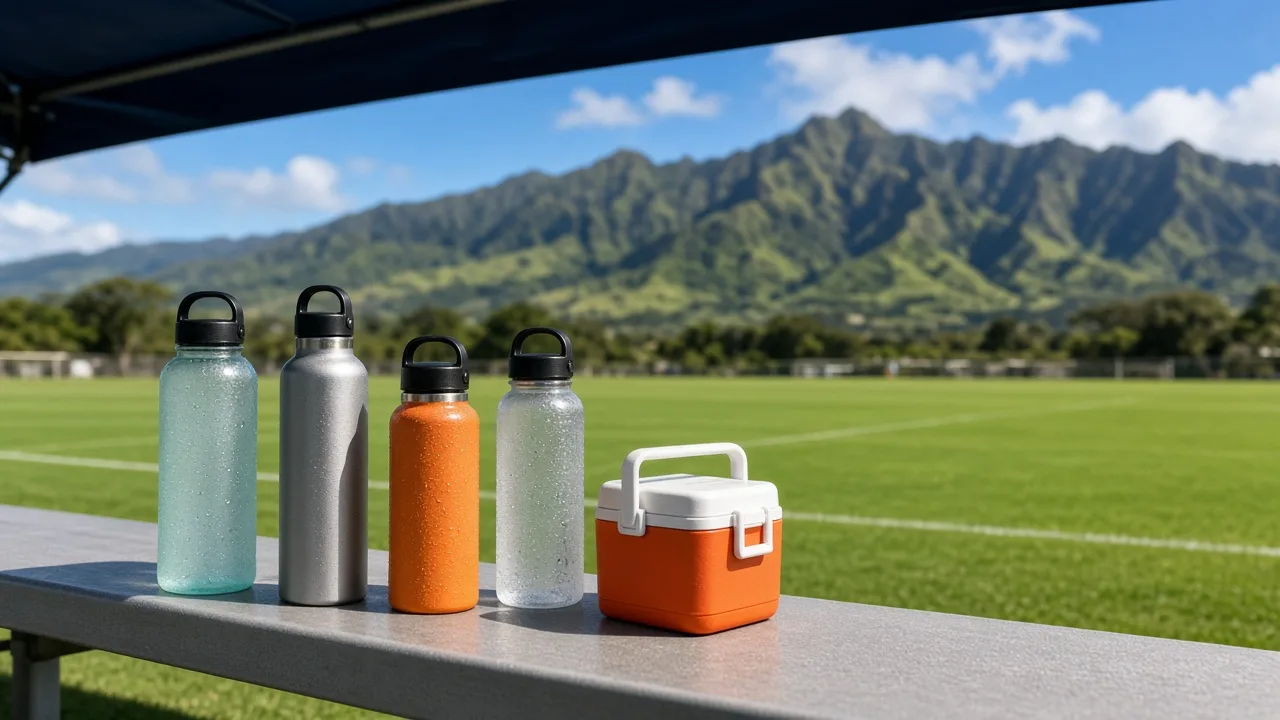
- Send a full water bottle every day. The AAP suggests chilled or frozen bottles, with a backup in the car.
- Drink before thirst hits. The CDC advises athletes to drink more water than usual on hot days and not to wait until they feel thirsty.
- Water anytime, not just on breaks. NATA says players should be able to get fluids whenever they need them during practice.
- Do a quick color check. Light yellow or clear urine usually means a child is drinking enough, according to the CDC.
- Older teens can try a weigh-in. NATA’s goal is to lose no more than 2% of body weight from the start to the end of a practice. For a 120-pound athlete, that’s about 2.4 pounds. NATA notes that losing as little as 2% can hurt performance and the body’s ability to control its temperature.
- Water plus a little sodium. The Korey Stringer Institute encourages both water and drinks with sodium. Our fueling guide covers sports drinks, why energy drinks don’t belong in the cooler, and why drinking far too much water can also be harmful.
- Sleep, eat and sit out when sick. The institute recommends 6 to 8 hours of sleep and balanced meals, and lists fever and stomach illness among the things that raise heat stroke risk.
Questions to ask your coach
- Does our team have a heat policy and an emergency action plan for this field or gym? (The AAP encourages parents to check; NATA says every site should have a plan that staff practice.)
- How do you decide when to shorten, move or cancel practice on hot days?
- Is an athletic trainer on site, and are ice, cold towels or a cold-water tub ready before practice starts?
- Are there regular breaks in the shade?
Just as important: let your keiki know it’s okay to speak up. The AAP notes many young athletes push through warning signs because of pressure from coaches or teammates, and it encourages kids to watch out for one another.
Warning signs to know
According to the AAP, an overheating child may have:
- Muscle cramps
- Dizziness or headache
- Nausea or vomiting
- Heavy sweating, or cold and clammy skin
- Sleepiness, confusion or clumsiness
These can point to heat exhaustion. Stop activity right away. NATA’s first steps are moving the player to shade or a cool spot, taking off extra clothing and gear, cooling with cold towels, and having them lie down with their legs raised. NATA advises getting a doctor involved if a player doesn’t recover quickly, and calling EMS if things get worse.
Heat stroke is an emergency. Watch for a player who is confused, irritable or acting “out of it,” staggering, collapsing or passing out. Two myths to drop: a child who is still sweating can still have heat stroke (NATA says most athletes with exertional heat stroke have hot, sweaty skin), and forehead, ear or mouth thermometers aren’t accurate for an athlete exercising in the heat, according to the Korey Stringer Institute. Don’t wait for a number.
What to do in an emergency: call 911 and cool fast
- Call 911 right away, or have another adult call while you start cooling. Alert the athletic trainer or coach.
- Stop and move the player to shade. Remove pads, helmet and extra clothing.
- Cool as fast as you can. Cold-water immersion in a tub is the best method. If there’s no tub, cover as much of the body as possible with cold, wet towels, swapping them out often. NATA says that if no medical staff is there, coaches and adults should keep cooling until help arrives.
- Keep watching breathing and responsiveness until EMS takes over.
Speed is everything. NATA reports that when exertional heat stroke is treated with rapid whole-body cooling and body temperature is brought back down within 30 minutes of collapse, survival has been 100%, with little or no lasting harm. Afterward, the institute recommends a doctor’s clearance, at least a week off exercise and a slow, supervised return.
The bottom line
Water bottle in the bag, shade and breaks at practice, a slow start to each season and a plan everyone knows. A few simple habits help our keiki keep playing safely all year.
Coaches, athletic trainers or health professionals on Maui with heat safety tips for young athletes and their families? Send them to us and we may feature them in a future story.
Korey Stringer Institute, University of Connecticut, “Exertional Heat Stroke”
Korey Stringer Institute, University of Connecticut, “Heat Acclimatization”
Centers for Disease Control and Prevention, Heat and Health, “Heat and Athletes” (2024)
Centers for Disease Control and Prevention, Heat and Health, “About Heat and Your Health” (2026)
This article is general information, not medical advice. Talk with a health professional about your child’s needs.